
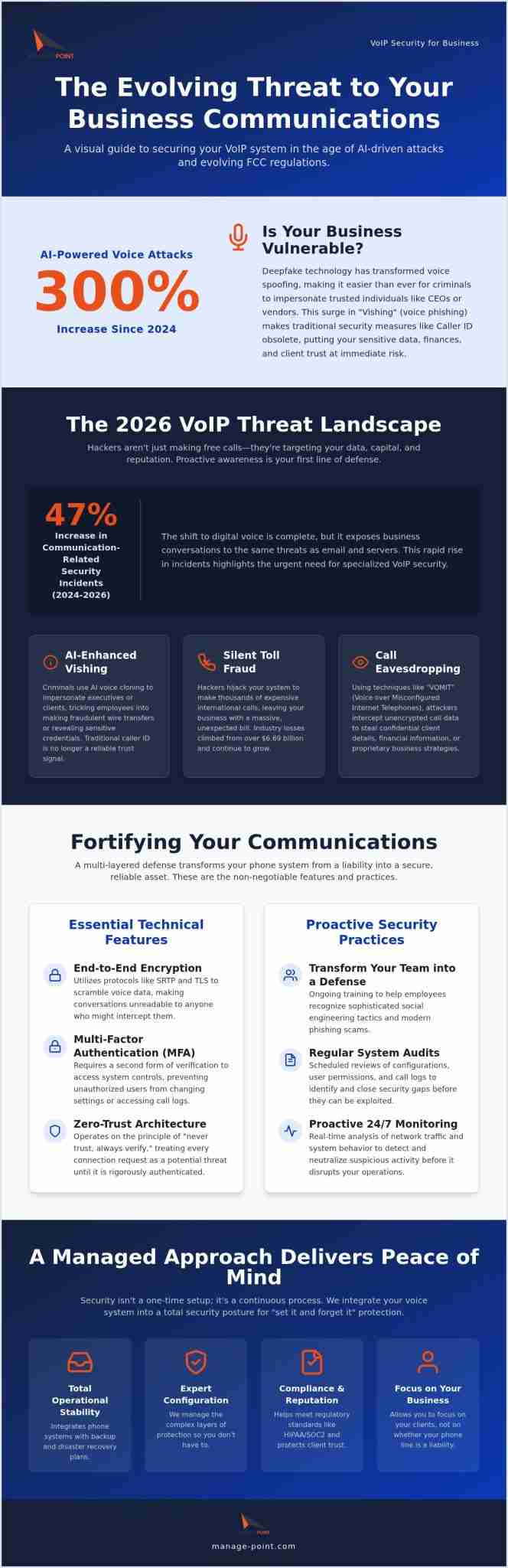
Did you know that deepfake voice attacks have surged by 300 percent since 2024? It’s a startling figure that makes many local business owners wonder if their private conversations are truly private. You likely chose a digital phone system for its efficiency, but the fear of eavesdropping or massive “toll fraud” bills can quickly turn that convenience into a source of stress. We believe you should be able to focus on your clients, not on whether your phone line is a liability. Achieving robust voip security for business doesn’t have to be a technical headache or a source of constant anxiety.
We understand that terms like SRTP or TLS sound like alphabet soup when you’re just trying to run a company. This guide is designed to cut through that noise and provide a clear path to a “set it and forget it” secure environment. You’ll discover how modern strategies like zero-trust architecture and compliance with new 2026 FCC regulations can shield your reputation. We are going to look at the proactive steps that bridge the gap between complex technology and the human trust your business is built on. It is about giving you the peace of mind that comes from knowing your communications are stable, private, and protected.
Key Takeaways
- Understand the evolving 2026 threat landscape, including how AI-driven vishing and silent toll fraud can drain your resources without warning.
- Learn the non-negotiable features of voip security for business, such as end-to-end encryption and multi-factor authentication, to keep your conversations private.
- Discover how to transform your team into a proactive line of defense by teaching them to recognize sophisticated, modern social engineering tactics.
- Establish a secure, “set it and forget it” environment through regular system audits and proactive monitoring that identifies risks before they disrupt your day.
- Explore the benefits of a managed approach that integrates your phone system with backup and disaster recovery for total operational stability.
Why VoIP Security is the Foundation of Modern Business Continuity
By 2026, the transition from traditional copper wires to digital voice is complete. Your office phone is no longer just a piece of hardware on a desk; it’s a sophisticated node on your network. This shift brings incredible flexibility, but it also means your conversations are now data packets vulnerable to the same threats as your email or server. Prioritizing voip security for business is no longer a luxury for the tech-savvy; it’s the bedrock of operational stability. When your voice data is unprotected, a single breached call can compromise years of carefully built client trust in seconds.
At ManagePoint, we view your voice system as a critical asset in your total security posture. It’s the primary way you handle sensitive client details, legal strategies, and financial data. If that stream is intercepted, the cause and effect are immediate. An unsecured system leads to unauthorized access; that access leads to data loss or crippling downtime; and that downtime leads to a damaged reputation that’s difficult to repair. We work to ensure your technology supports your long-term objectives rather than creating new liabilities.
The Real Cost of Communication Breaches
The financial impact of a breach goes far beyond a temporary service outage. Toll fraud remains a massive threat in 2026, with industry losses projected to grow significantly from the $6.69 billion reported just a few years ago. Hackers can hijack your system to make thousands of international calls, leaving you with a bill that could bankrupt a small firm. Beyond the direct costs, the reputational damage of a leaked confidential strategy can be permanent. For those in healthcare or legal sectors, failing to secure these lines can result in heavy regulatory fines for non-compliance with HIPAA or SOC2 standards. It’s about protecting your bottom line and your professional standing simultaneously.
Moving from “Phone Lines” to “Secure Data Streams”
It helps to understand that VoIP technology treats your voice as just another set of packets on your network. This is why residential-grade services often fail professional security standards. They lack the robust encryption and administrative controls required to fend off modern hackers. We provide a steady hand to manage these complex configurations so you don’t have to. By treating your phone system as a secure data stream, we implement layers of protection that keep your conversations private and your connection uninterrupted. This proactive approach allows you to focus on your neighbors and your business while we watch the background noise.
Identifying the 2026 VoIP Threat Landscape: From Vishing to Toll Fraud
The landscape of voip security for business has shifted dramatically in just a few short years. By mid-2026, we have seen a 47 percent increase in communication-related security incidents compared to 2024. Hackers are no longer just looking for a way to make free calls. They want your data, your client’s trust, and your company’s capital. Understanding these modern threats is the first step toward building a defense that actually works. We see these risks every day; we believe a proactive stance is the only way to maintain your peace of mind.
The Rise of AI-Enhanced Voice Spoofing
Deepfake technology has changed the game. Attacks involving voice cloning have surged by 300 percent since 2024, allowing criminals to impersonate your CEO or a trusted vendor with terrifying accuracy. Vishing is the modern evolution of the phone scam, where attackers use voice-based social engineering to manipulate victims into revealing sensitive information. Because of this, traditional caller ID is no longer a reliable trust signal. If a voice on the other end asks for an urgent wire transfer or a password reset, you cannot assume it is who it says it is. This is why we focus heavily on training your team to spot these sophisticated red flags.
Technical Exploits: Toll Fraud and Call Tampering
While vishing targets your people, technical exploits target your hardware. Toll fraud is a silent profit-killer that involves hackers hijacking your SIP trunks to route expensive international traffic through your account. These losses reached $6.69 billion back in 2021 and have continued to climb into 2026. Criminals also use VOMIT, or Voice over Misconfigured Internet Telephones, to engage in packet sniffing. This allows them to intercept and record your private conversations as they travel across the web. According to the Voice over Internet Protocol (VoIP) guidelines provided by the FCC, these vulnerabilities often stem from simple configuration errors that a steady hand could have prevented.
Finally, we have to consider DDoS attacks. These are not just for websites anymore. Malicious actors can flood your communication servers with traffic to paralyze your operations, leaving you unable to reach clients when they need you most. The FCC’s tighter “Know-Your-Customer” obligations, introduced in April 2026, are helping to mitigate some risks, but they do not replace a solid internal defense. If you notice unexpected spikes in international calling or sudden, unexplained system lag, your server might be compromised. Our team at ManagePoint specializes in cybersecurity and proactive monitoring so these technical distractions never disrupt your daily business flow.
Essential Features of a Secure Small Business Phone System
After identifying the risks, it’s time to build your shield. A robust voip security for business strategy relies on several non-negotiable features. These aren’t just technical checkboxes; they’re the tools that ensure your conversations remain private and your operations stay steady. We focus on these layers so you can enjoy the clarity of digital voice without the stress of vulnerability. It’s about creating an environment where technology works for you, not against you.
The Technical Shield: SRTP and TLS
Encryption is often discussed as a general concept, but it requires specific protocols to be effective. Secure Real-time Transport Protocol (SRTP) is what actually scrambles your voice packets as they travel across the internet. Without it, anyone with the right tools can “listen in” on your calls. However, SRTP only protects the audio itself. You also need Transport Layer Security (TLS) to shield the signaling and metadata. This includes details like who you called and when. A professional provider must support both to provide total privacy. We ensure these protocols are active from the handset all the way to the cloud.
Access Control and User Management
Technology is only as strong as the people who access it. Implementing Multi-Factor Authentication (MFA) for all administrative logins is a vital step in preventing unauthorized changes to your system. It’s also important to establish role-based access. This means your team members only have the permissions they need to do their jobs. You can use this business phone service comparison to see how different providers rank on these security-first features. We recommend strict password policies for every desk phone and mobile app to keep the “front door” of your communications locked.
Beyond user access, your network infrastructure needs proper organization. We use network segmentation to keep your voice traffic on a separate path from your general data. This prevents a breach in one area from automatically compromising the other. Finally, automatic firmware updates are essential. New vulnerabilities emerge frequently, such as the flaw affecting Grandstream GXP1600 phones that required a patch in February 2026. Proactive patching ensures your hardware is always running the most secure software version available. If you are planning a new deployment or upgrading existing hardware, our guide on how to implement a VoIP phone system walks you through choosing the right equipment and configuring it securely from the start. We do this heavy lifting in the background so you never have to worry about the latest technical fix.
Best Practices for Hardening Your VoIP Infrastructure
Hardening your setup is about creating a resilient environment where threats have nowhere to hide. While encryption and MFA provide the foundation, your daily habits and network configuration determine your long-term success. Implementing robust voip security for business means looking at every point of entry, from the software in your cloud to the physical wires in your server room. We believe in a proactive approach that stops trouble before it starts. It’s about moving beyond basic settings to achieve total operational stability.
Regular audits of your phone system logs are essential. These records show you who is calling, when, and from where. If you see unauthorized login attempts or international traffic during hours your office is closed, you can shut down a toll fraud attempt before the bill arrives. Additionally, ensure your firewalls are configured for VoIP-aware traffic. Correcting features like SIP ALG (Application Layer Gateway) can prevent frustrating call drops while ensuring your security rules remain airtight. Don’t forget the physical side; keeping your server rooms and on-site hardware locked prevents “insider” exploits or accidental tampering.
The Human Firewall: Training Your Team
Technology alone cannot stop a clever social engineer. Your team needs a culture of verification where “urgent” requests for sensitive data are met with a quick follow-up call to a known number. Establish standard operating procedures for handling requests that seem out of character for executives, even if the voice sounds familiar. Because hackers target psychology as often as they target code, your employees are the front line of your defense. Training them to recognize and report suspicious activity immediately turns a potential breach into a minor footnote. This neighborly vigilance is often the difference between a secure day and a costly disaster.
Network Optimization for Security and Quality
Proper network organization prevents a small problem from becoming a total disaster. We utilize VLANs (Virtual Local Area Networks) to isolate your voice traffic from your general data network. This ensures that if a workstation is compromised by malware, the infection cannot easily move laterally to your phone lines. Quality of Service (QoS) settings also play a role by prioritizing voice packets. This maintains clear, secure connections even when your data network is under heavy load. It’s a strategic way to ensure that your communication remains the steady hand of your business.
Managing these intricate layers requires constant attention and technical expertise. Our managed it services provide the proactive monitoring needed to catch these network issues in real-time. We watch over your interests in the background so you can focus on your neighbors and your growth. If you are ready to lock down your communication infrastructure and find true peace of mind, you can get started with a proactive security assessment from our local team today.
Why a Managed Approach to VoIP Security Provides True Peace of Mind
Security isn’t a one-time setup; it’s a continuous commitment to your company’s safety. While the technical features we’ve discussed are vital, managing them shouldn’t be your second job. A managed approach to voip security for business shifts the burden from your shoulders to ours. It moves your strategy from reactive “fixing” to proactive “protecting.” Instead of waiting for a massive bill or a dropped call to signal trouble, you have a partner ensuring those disruptions never happen in the first place.
We believe that true peace of mind comes from knowing a local team is watching your network. ManagePoint acts as a protective guardian, monitoring your systems in the background so you can focus on your daily operations. This proactive stance pays off. According to 2026 industry data, organizations that deploy proactive security AI and automation save an average of $2.22 million in breach costs compared to those that don’t. We use these advanced tools to provide that same level of enterprise-grade protection to our neighbors right here in the community.
Our approach also integrates your voice system with your broader Backup & Disaster Recovery plan. If a local outage occurs, your communication shouldn’t stop. We ensure your voice traffic can failover seamlessly, maintaining 100 percent uptime. This alignment ensures that your phone system isn’t just a tool, but a reliable pillar of your business continuity strategy.
The vCIO Advantage: Strategic Voice Planning
Technology should never feel like “noise” that complicates your day. Our IT consulting and vCIO services help you cut through the technical jargon to align your phone system with your long-term goals. We help you stay ahead of industry-specific compliance requirements, such as HIPAA or SOC2, ensuring your voip security for business meets every legal standard. Whether you’re planning for a new office or expanding your remote team, we provide the strategic roadmap to ensure your communication infrastructure grows with you without creating new vulnerabilities.
24/7 Monitoring and Proactive Response
A secure system requires a watchful eye that never blinks. Our security operations center (SOC) monitors for red flags like toll fraud or unauthorized access attempts around the clock. If a potential threat is detected, we don’t just send an alert; we follow rapid response protocols to neutralize the risk immediately. This is the “steady hand” ManagePoint provides in an increasingly complex digital world. We’re committed to your success and safety because we aren’t just a global IT firm; we’re your neighbors who value longevity and honesty in every partnership.
Building a Future of Secure and Reliable Communication
Your phone system is the heartbeat of your client relationships. In an era where deepfake voices and automated fraud are on the rise, staying ahead of these threats is essential for your peace of mind. We have explored how robust voip security for business combines technical protocols like encryption with the “human firewall” of team training. By moving away from reactive fixes and toward a managed, proactive strategy, you ensure your business remains open and your reputation stays protected.
ManagePoint brings over 20 years of infrastructure expertise to every partnership. We don’t just set up phones; we provide a comprehensive suite where cybersecurity and disaster recovery work together to keep you online. Our local, proactive support means you have a neighbor watching your network around the clock. You deserve technology that provides stability rather than stress. Secure your business communications with ManagePoint’s expert VoIP solutions today. We are here to be the steady hand that guides you through the evolving digital landscape. Let’s build a secure foundation for your future success together.
Frequently Asked Questions
Can a VoIP phone system be hacked like a computer?
Yes, a VoIP phone is essentially a specialized computer connected to your network, making it susceptible to similar vulnerabilities. Hackers can target unpatched firmware or weak passwords to intercept calls or gain access to your broader data environment. This is why we emphasize regular software updates and robust password policies. Treating your phone system with the same security rigor as your servers ensures your communication remains a protected asset rather than an easy entry point.
Is VoIP more or less secure than a traditional landline?
VoIP is inherently more secure than traditional landlines when properly configured with modern encryption protocols. Unlike old copper wires that can be physically tapped with simple tools, digital voice packets can be scrambled using SRTP and TLS. This ensures that even if data is intercepted, it remains unreadable. While the digital nature introduces new risks, the ability to monitor and encrypt your traffic provides a level of privacy that physical landlines simply cannot match.
What is vishing and how can my employees spot it?
Vishing is the use of fraudulent phone calls to trick employees into revealing sensitive information or transferring funds. Your team can spot these attacks by looking for high-pressure tactics or requests that deviate from standard operating procedures. With the rise of AI voice cloning in 2026, employees should always verify “urgent” requests by calling the person back on a known, trusted number. Creating a culture of verification is your strongest defense against these social engineering tactics.
What are the most important security features to look for in a new phone system?
The most critical features for robust voip security for business are end-to-end encryption and Multi-Factor Authentication (MFA). Encryption ensures your conversations stay private, while MFA prevents unauthorized administrative changes to your routing or user settings. You should also prioritize systems that offer automatic firmware patching and detailed call logging. These tools work together to create a “set it and forget it” environment where your communication is shielded from both technical exploits and unauthorized access.
How does network segmentation improve my VoIP security?
Network segmentation improves security by placing your voice traffic on a separate Virtual Local Area Network (VLAN) from your general data. If a workstation on your main network is compromised by malware, the segmentation prevents that infection from moving laterally into your phone system. This isolation ensures that your primary communication lines remain clear and secure even during a data breach. It’s a strategic way to maintain operational stability and protect sensitive client conversations.
Will adding security features slow down my call quality?
Properly implemented security features won’t slow down your call quality or cause noticeable lag. We use Quality of Service (QoS) settings to prioritize your voice packets, ensuring they travel quickly across your network even when encryption is active. By balancing security with performance, we provide a clear, crisp connection that doesn’t compromise on safety. You get the peace of mind of a locked-down system without the frustration of dropped words or technical delays.
What should I do if I suspect my business is a victim of toll fraud?
If you suspect toll fraud, you should immediately contact your service provider to review your call logs and disable international dialing. Look for red flags like unexplained spikes in your bill or calls made during after-office hours. Rapid response is key to minimizing financial damage, as these costs can escalate in a matter of hours. Once the immediate threat is contained, we conduct a full audit to identify the vulnerability and harden your system against future hijacking attempts.
How does ManagePoint ensure my VoIP system stays HIPAA or SOC2 compliant?
We ensure compliance by aligning your voip security for business with specific regulatory frameworks through proactive vCIO consulting. This includes implementing mandatory end-to-end encryption and strict access controls that meet the privacy requirements of HIPAA and SOC2. Our team handles the documentation and monitoring needed to prove that your communication streams are secure and private. We take the guesswork out of compliance so you can focus on serving your clients with confidence and integrity.